Sept 12, 1940 – Cave Art And Meddling Kids

On September 12, 1940, near Montignac, France, four teenagers followed their dog down a narrow cave entrance and discovered a caveLascaux2 full of the worlds best examples of Paleolithic Era cave art.  The cave, named Lascaux Cave, contained over 600 paintings and 1500 engravings of a variety of animals and mythological creatures said to date back as far as 17000 B.C.  Of all the paintings and engravings, there is only one representation of the human form.  The figure is dressed entirely in black with a black beret and is clearly being condescending to the other painting, proving that French artists were pretentious jerks even back then.
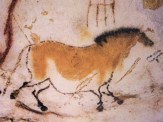
The cave was opened to the public in 1948, but had to be closed again in 1963 as the artificial lighting and tourist’s stanky breath had noticeably degraded the vivid colors of the paintings.  In 1983, a replica cave was opened to the public in which cave officials claimed that painstakingly crafted recreations allowed its visitors the experience of the original cave without having to compromise its integrity.  In actuality, the replica cave was finger-painted by Ms. Dubois’ third grade class from Montignac Elementary School.  It still draws thousands of tourists each year.  Unfortunately, the third graders were strong armed into signing releases and were therefore not entitled to any royalties coming from entry fees.

As for the original four kids and their dog, they went on to solve a series of mysteries all over the French country side.  In the late 1960’s, American writers Joe Ruby and Ken Spears learned of the teen’s exploits and created a television show around the concept.  On September 13, 1969, 29 years and 1 day after the cave was discovered, “Scooby Doo, Where Are You!” aired on CBS and became an American classic.  As tribute to a their French inspiration, an episode was crafted around Scooby and The Gang finding a cave of ancient art.  The episode did deviate from the original story though, in that the cave was suspected to be haunted and Don Knotts and the Harlem Globetrotters helped the group unmask a cantankerous old farm couple who wanted to drive the tourists from their land.  They would have got away with it too if it wasn’t for those meddling kids and their dog.

*Note:  There are actual two dates in this post applicable to this week.  You’re welcome.
Edwin Land

“A picture is worth a thousand words… and a piece of your soul.”

-Edwin Land, inventor of the Polaroid camera, circa 1932; After spending a semester in Australia on a “study abroad” program through Harvard, Land became fascinated with the Australian Aborigine’s belief that a photograph could actually steal a portion of a person’s soul.  Secretly, Land took to this belief himself and devoted much of his career to developing his soul stealing technology.  His crowning achievement was the public release of his instant develop Polaroid camera in late 1948 (Land had lobbied to name the camera the “Soul Swapper 5000” but was voted down by the company’s board of directors).  Upon his death in 1991, it is rumored that his personal assistant discovered his “collection of souls”, which consisted of over 5 million Polaroids of complete strangers.  His assistant promptly had them all shredded to avoid Land being dubbed “a real creeper” in the public’s mind. (Fun sub-fact:  Land’s personal assistant was actually a man named Ed Roland, who would later become the leader singer for the band Collective Soul.)

The Prince Of Nigeria

The rusty door to my mailbox was hanging open.  I peered in, as I always do before sticking my hand into small, dark spaces.  Inside was a ragged envelope which sat partially crumpled atop the regular mail.  I could see before picking it up that the return address was in an unfamiliar language and my address had been penned by a hand unskilled in English.  I knew immediately who it must be from.  

My neighbor Frank had mocked me when I told him about the e-mail I’d received a month ago.  “You’re so gullible”, he always told me, “someday it’s going to bite you.”  As alway, I ignored his warning and sent a $2,000 via Western Union to aid Prince Faramade of Nigeria in regaining his throne.  Frank waved me off, when I tried to tell him it was a smart investment.  He had muttered something about eating spam and then went back to tinkering with the old toys he was trying to fix in his garage.

Sliding my finger under the envelope flap, I tore it open.  Inside was a handwritten letter, signed by the Prince himself.  The first half was a gushing thank you for my monetary support, the second, as I had suspected, was a set of instructions to lead me to my reward.  I couldn’t wait to shove this in Frank’s face.  

Following the instructions, I walked down the block to the city park.  There, right where the letter said it would be, under the willow tree next to the pond, was a freshly dug patch of earth. As I sunk to my knees, all I could think about was the smug smile being wiped off Frank’s face.  

My hands began to pull away the dirt; a task that proved to take longer than expected.  Whatever was buried here, was buried deep.  As I dug deeper, one side of my hole began to give way, revealing a small cavern that evidently stretched under the tree’s root system.  It was too dark to see inside, but I knew this had to be it, so I plunged my hand into the unknown.

I groped blindly along the damp dirt floor, reaching farther and farther into the small cavern. It wasn’t until my arm had fully disappeared, that I felt the smooth surface of a metal box.  My heart jumped into my throat.  Within seconds, I was sitting over a small chest under the shade of the willow.  The box itself was made of old tin and had, at one time, been festively decorated, though time had taken its toll.  A small brass placard with the letter “F” adorned the top. My heart was racing now and a small brass latch was all that stood between me and what was sure to be a life altering prize from Prince Faramade.  

The box was heavy and its contents shifted within.  It wasn’t big enough to be a large amount of cash. Precious stones, I thought.  Fingers trembling, I lifted the brass latch.  As the latch left the catch, the box sprung open violently.   The head of a clown exploded toward my face and caught me between the eyes.  I wasn’t proud of my scream, but it escaped my lips nonetheless.  I stumbled back before catching myself, my eyes following the bobbing head of that silly jack-in-the-box.  Across its forehead, someone had scrawled a message in marker.  “A fool and his money…” was all it read.

I was dumbfounded.  Why would he do this?  Why go through all this trouble?  Why send me on this wild goose chase?  

Leaving the box and the hole, I raced back down the street to my house.  My fears were confirmed when I rounded the corner into my driveway.  I could see my front door was hanging open.  Without thinking, I barrelled into the house and to my relief found no one inside.  What I did find, was the now empty spot where my big screen TV had once been.  

Slouching onto the steps of my front porch, I put my head in my hands.  How could I have been so dumb?  Looking up, I could see Frank in his yard, hosing the dirt off of a shovel.  He was going to have a field day with this, I thought.  He’s never going to believe I was robbed by the Prince of Nigeria.

***This short story previously NOT published in an issue of Writer’s Digest as a short story competition winner. 

“Ask Brett” – Hooah Bars and Rip Its – Aug. 21

On August 10, O.E. Wrote::

Dearest Colleague and War-Pal,

It would be a great pleasure to read your thoughts on the Army’s former use of the hooah bar and the famed ripits (sic) and the impact these nutritional/energy aids had on increasing the probability of both IED strikes and negligent discharges.

Additionally, aside from being Tinker Bell’s fairy sister, what are you thoughts on, Periwinkle, the color of course and not the flower.

Dear O.E.

First and foremost, I feel I must explain to my “civilian” readers, what “Hooah Bars” and “Rip Its” are. Both are “energy aids” provided by the Army to our U.S. Soldiers in current combat theaters. The Hooah Bar is a compacted mixture of sugar, whey protein, cow dung, sawdust and sadness (and occasionally dipped in chocolate). Its texture and taste were similar to that of composite decking materials. The Rip It is a goat pee based energy drink, which is served in incredibly small cans to promote maximum aluminum waste. As for your original inquiry, I do not believe either item increased the probability of IED strikes, but the violent spasms these invoke have definitely led to a fair amount of negligent discharges (the Army’s term for the accidental firing of one’s rifle, pistol, grenade launcher, canon, TOW missel, etc…).

Finally, on Periwinkle. I’m glad you clarified between the color and the flower. I don’t think anyone wants to hear another one of my tirades on Periwinkle the flower. As for the color, I’m more of a Lavender guy, but what do I know…

Thank you for your inquiry!

Brett

Yoda

“Do… or do not.  Care less, I could not.”

-Yoda, excerpt from the original draft of the Star Wars: Episode V script, circa 1978; The part of Yoda was originally earmarked to be played by an aging Marlon Brando, but after multiple readings George Lucas decided it was too gritty a take on this crucial character.  To fill the role, Lucas approached his puppeteers asking for a cross between Brando and Kermit the Frog.  I think you’ll agree they hit the nail on the head.

August 16, 1896 – What Would You Do For A Klondike… Nugget?

On August 16, 1896, George Carmack sparked the last great gold rush in the America’s when he discovered a large nugget of the metal while salmon fishing in Rabbit Creek in the Yukon Territory in Canada.  Despite the lack of Facebook, Twitter, Instagram, or even MySpace, word of Carmack’s discovery went viral.  Over the next two years, it is estimated that over 100,000 people ventured to the Klondike to seek their fortune.  Most who were fortunate enough to return home after the rush, did so with nothing more to show from their trip than frostbitten limbs and an assortment of venereal diseases.   

For George Carmack, also known as “Lyin’ George” by his Native American companions due to his exaggerated claims, life would never be the same.  Returning to his native California at the end of the Rush with over $1 million to his name, Carmack found it difficult to lead a modest life (ironically while living in Modesto, California).  It wasn’t long before Carmack left his Native American wife and ran off with some floozy to Seattle (Seattle was apparently considered very exotic at the end of the 19th Century).  Expanding his wealth further through real estate ventures, Carmack’s lavish lifestyle became that of legend.  

It is said that shortly after the turn of the century, Carmack began insisting all visitors to his home refer to him as “King Midas”, after the legendary Greek king who could turn anything to gold with his touch.  He is also said to have created the first set of gold teeth covers (or “grills”), though the trend would not catch on for another century.  Most historians credit George Carmack for setting the example of lavish living that modern pop artists still try to emulate today.  

Even with his excessive wealth, George Carmack was never truly happy.  For years he continued to prospect for gold, hoping to recreate the excitement of the major discovery from his youth.  In June of 1922, while prospecting a new claim in the Cascade Mountains, historians believe that Carmack finally finished reading Jack London’s, Call Of The Wild, dropped everything, ran off with a pack of wolves, and was never heard from again.

Klondike

Sir Isaac Newton

“If I have seen further than others, it is by standing upon the shoulders of giants.  If I have moved faster than others, it is by sitting on the backs of unicorns.  If I end up living longer than others, it is because I’ve boobi-trapped the underside of my bed against boogie-men.”


-Sir Isaac Newton, in a letter to friend, Robert Hooke, February 15, 1676; Though a brilliant scientific mind, Sir Isaac Newton was a staunch believer in all kinds of mythical creatures.  His absurd claims annoyed his more envious friends, and he often attributed his discoveries to these outlandish encounters.  For example, Newton claimed to have thought of his First Law of Motion when he was thrown from the back of a minotaur because it stopped too quickly.  His family made up the thing about the apple falling from a tree after his death as a means of saving face.

August 7, 1959 – COL Ivan Bananapants

On August 7, 1959, the unmanned spacecraft, Explorer 6, is launched into orbit from the Atlantic Missile Range in Cape Canaveral, Florida.  Taking over 40 minutes, from a height of 17,000 miles, and at speeds in excess of 20,000 miles per hour, Explorer 6’s photocell scanners transmit back a crude picture of the planet Earth.  This photograph by a U.S. satellite is commonly regarded as the first “planetary selfie” though it was so crude it really could have been anything.

First_satellite_photo_-_Explorer_VI * First “planetary selfie”.

Not to be outdone, the then U.S.S.R. launched their new monkey piloted spacecraft, Oppression 7, a month later on the same mission.  Due to pressure from the Kremlin, Russian scientists did not have time to mount photocell scanners to their spacecraft, but instead hastily taught their monkey pilot, COL Ivan Bananapants, how to operate a common personal camera.  Upon his return to earth, COL Bananapants’ photos were reviewed, but all were found to be unusable.  Only two photographs were of the planet Earth, but Mars had photobombed both.  The remainder of the film roll were selfies of COL Bananapants making annoying duck lips.

Though initially welcomed back to the U.S.S.R. as a hero, COL Bananapants was shunned by the public and soon descended into alcoholism.  Four months later the KGB picked him up under suspicions of espionage and he spent his remaining years delousing the inmates of a Siberian hard labor camp.  Stories among inmates of the camp claim that he was haunted to his last days by his failed mission and on clear nights he would venture into the camp courtyard and throw his feces at the moon.

COL Ivan Bananapants *Only known photo of COL Bananapants.  His space selfies were destroyed to avoid humiliation.


Nathan Hale

“I only regret that I have but one life to give for my country.  Were I a cat, I would have nine, and I’d give them all for my country.  How cooleth would that be?”

-Nathan Hale, September 22, 1776; Nathan Hale, American hero, spoke these words moments before being hanged by the British for espionage during the Revolutionary War.  Hale was survived by his brother Enoch and his 28 cats.  He had disturbing amount of cats.  This quote originally appeared in the “Patriot Cats” December 1776 issue of Cat Fancy magazine.

Hogwash Nature: Arctic Vampire-Bat

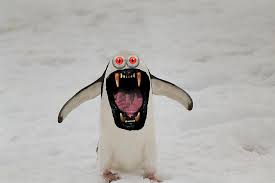
Scary Penguin

This, my friends, is not a penguin as some might think.  It is actually a rare Artic Vampire-Bat and even more rare is that they appear to have captured it on film mid yawn.  When this specific type of bat yawns it produces a frequency of sound-wave that will stop a human heart and scramble signals to the brain.  Tragically, the camera man who took this picture most likely did not survive his encounter.  The Arctic Vampire-Bat feeds primarily on Arctic Vampire-Mice, Arctic Vampire-Grasshoppers, and an assortment of Arctic Vampire-fruit.  They will not eat anything not of the Arctic Vampire family… except the occasional Mr. Goodbar which seems to be their guilty pleasure.  If you are ever cornered by a roving gang of Arctic Vampire-Bats (yes, they travel in gangs… and they rove instead of fly) put a mirror in front of them.  Unlike most Vampire species, the Arctic Vampire-Bat can indeed see its own reflection and is quite vain.

(Circa 2006)